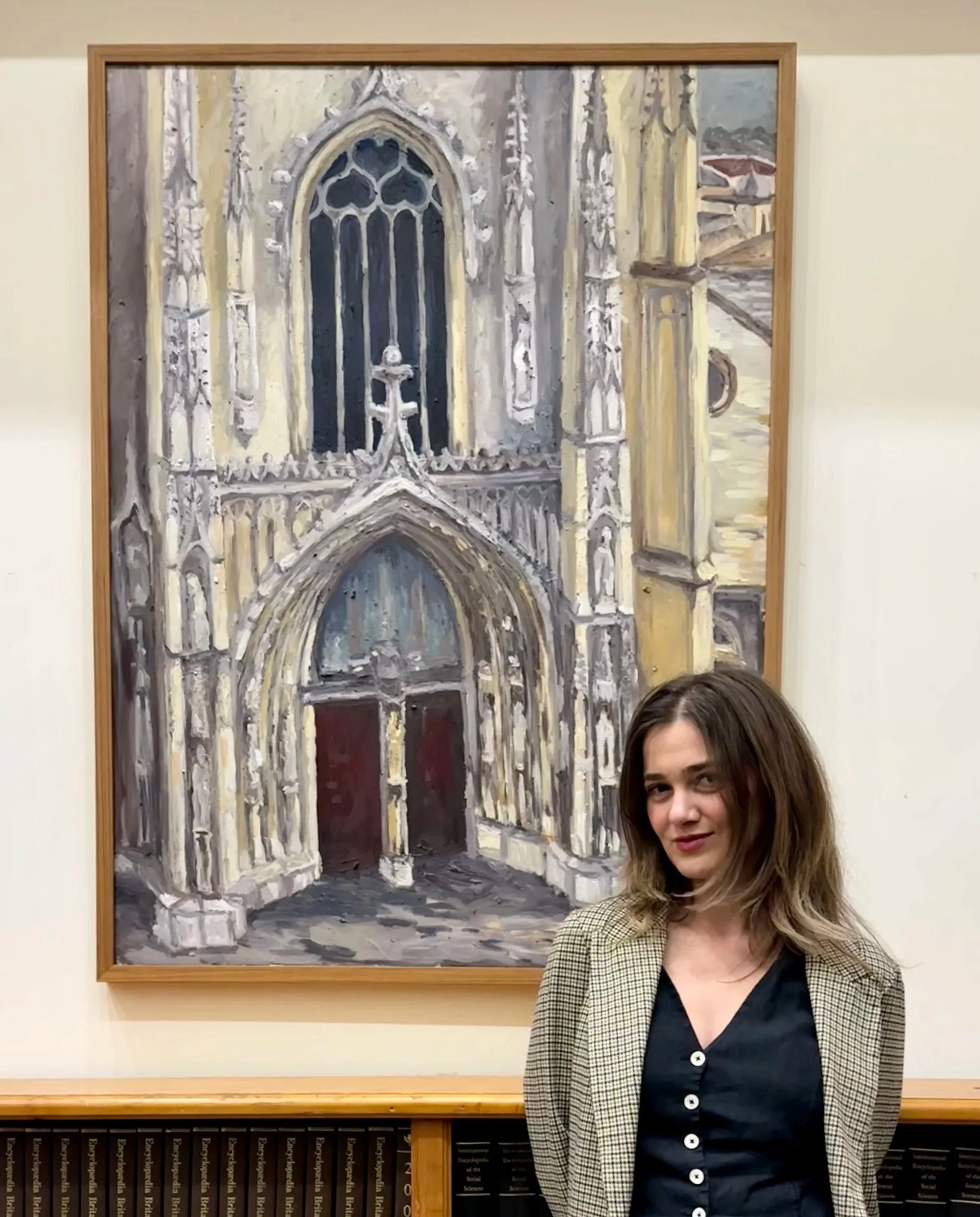
[EN] Peyton Espley-Jones is an American artist based in southern France working across painting and sculpture. Informed by her research on the wounded body in medieval art, her work reinterprets devotional imagery and religious iconography through a contemporary lens, where motifs of martyrdom, the Pietà, and the sacred wound become reflections on love, betrayal, devotion, and disillusionment.
Centered on the human figure, her paintings explores the body as a site of tension between reverence and violation, intimacy and exposure, strength and fragility. Forms emerge through blurred contours and layered surfaces into bodies that are elongated, compressed, and partially obscured.
Architecture, particularly the cathedral in Aix-en-Provence, acts as both a formal and a symbolic anchor. Its Gothic and Romanesque structure informs her palette and atmosphere, connecting her paintings to a place and an institution that is imposing yet intimately familiar to her.
Alongside her paintings, she creates sculptural objects using ceramic, wood, and gold or silver leaf. Referencing shrines and reliquaries, these works invite proximity and touch, bringing the sacred into a more immediate, bodily encounter.
In 2020, she received a B.A. in Art History and B.A. in Psychology from the University of Texas at Austin. While completing her undergraduate degree, she spent five months in France completing a certificate program in plein air landscape painting. She later returned to France and earned her M.A. in Art History (2023) and M.F.A. in Painting (2025) at the American College of the Mediterranean. Her work has been exhibited in France and is held in private collections and institutions in the United States and Europe.
[FR] Peyton Espley-Jones est une artiste américaine basée dans le sud de la France, dont la pratique s’étend de la peinture à la sculpture. Nourrie par ses recherches sur le corps blessé dans l’art médiéval, son travail réinterprète l’imagerie dévotionnelle et l’iconographie religieuse à travers un regard contemporain, où les motifs du martyre, de la Pietà et de la plaie sacrée deviennent des réflexions sur l’amour, la trahison, la dévotion et le désenchantement.
Centrée sur la figure humaine, sa peinture explore le corps comme un lieu de tension entre révérence et violence, intimité et exposition, force et fragilité. Les formes émergent à travers des contours flous et des surfaces stratifiées, donnant naissance à des corps allongés, compressés et partiellement dissimulés.
L’architecture, en particulier la cathédrale d’Aix-en-Provence, agit comme un ancrage à la fois formel et symbolique. Sa structure gothique et romane informe sa palette et son atmosphère, reliant ses œuvres à un lieu et à une institution à la fois imposants et profondément familiers.
En parallèle à ses peintures, elle réalise des objets sculpturaux en céramique, en bois, et en feuille d’or ou d’argent. Évoquant les reliquaires et les autels domestiques, ces œuvres invitent à la proximité et au toucher, rapprochant le sacré d’une expérience plus immédiate et corporelle.
En 2020, elle obtient une licence (B.A.) en histoire de l’art et en psychologie à l’Université du Texas à Austin. Au cours de ses études, elle passe cinq mois en France dans le cadre d’un programme certifiant de peinture de paysage en plein air. Elle revient ensuite en France, où elle obtient un Master en Histoire de l’Art (2023) ainsi qu’un Master en Beaux-Arts en peinture (2025) à l’American College of the Mediterranean. Son travail a été exposé en France et figure dans des collections privées et institutionnelles aux États-Unis et en Europe.